AI Guardrails: Test Inputs, Actions and Outputs
Learn how AI guardrails check inputs, actions and outputs. Run a 16-case Python lab covering approval changes, stale state, retries and failed checks.
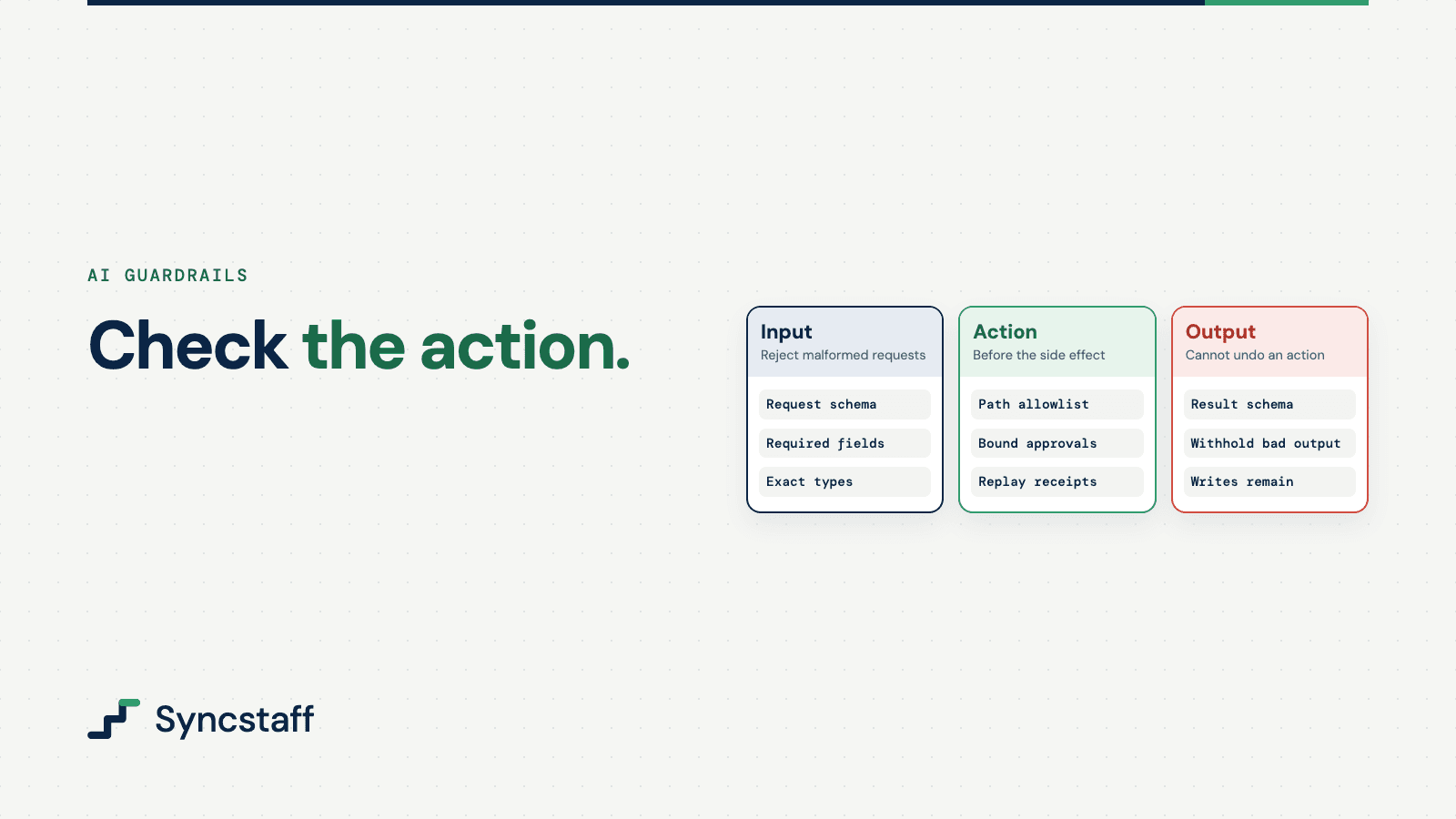
AI guardrails are checks that constrain what an AI system receives, does and returns. For a coding agent, useful guardrails inspect the request, authorize the proposed action before it changes anything, and validate the result. Start with explicit rules, then test allowed work, denied work and failures of the checks themselves.
A prompt asking an agent to be careful gives the model guidance. An enforced rule belongs at the point where the tool can actually perform an action. The distinction becomes visible when an agent retries a write, changes a plan after approval, or receives a result that looks successful even though a check failed.
For this article, we ran a standard-library Python lab with 16 controlled cases. It tests request schemas, path restrictions, approvals bound to exact changes, stale state, retries and output validation. Two cases deliberately show the limits: instruction-like text passes an authorized document write, and rejecting a malformed result does not undo a completed write.
What do AI guardrails protect?
AI guardrails protect boundaries around a system's inputs, permissions, actions and outputs. The controls you need depend on the harm you want to prevent. A customer-support assistant needs different restrictions from an agent that can edit deployment configuration. Define the resource and consequence before choosing the check.
The research overview of LLM risks and guardrails emphasizes testability, fail-safes and risks from agents that can act. For engineering teams, that means recording what an agent can affect, how you detect a mistake, and where execution stops.
| Checkpoint | Example control | Useful evidence | What it does not establish |
|---|---|---|---|
| Input | Request schema, data classification, secret screening | Malformed requests rejected; sensitive examples labeled | Whether a valid action is authorized |
| Action | Tool and resource allowlists, scoped credentials, approvals | Denied calls cause no new side effects | Whether the model's reasoning is correct |
| Output | Result schema, factual checks, disclosure checks | Invalid results withheld or marked incomplete | That an earlier write or payment was reversed |
| Runtime | Filesystem isolation, network restrictions | Attempts outside granted permissions fail | Whether an allowed action is appropriate |
| Human review | Approval of a specific consequential change | Decision tied to the reviewed artifact | Permission for a different change later |
A content classifier can help detect an unsafe request. A schema can reject a wrong type. An authorization service decides whether this identity may perform this operation on this resource. These checks have different jobs. Test them separately and connect their decisions explicitly.
Use this page as a map, then test each boundary in its own guide: agent identity and project access for attribution and resource scope; MCP authentication for remote tool access; LLM router audit trails for model-selection and retry evidence; and self-hosted AI agents for runner, network and data boundaries. These controls complement one another; none proves the others.
Why a fleet needs more than a policy document
Komodor's 2026 Agentic Operations Survey landing page describes responses from 1,000 engineering, IT and technology leaders about production operations. It reports that 83.9% run more than ten operational agents. Its issuer announcement says 75.7% maintain restrictions such as read-only tasks or human approval.
Those are vendor-reported findings about operational agents. They do not describe every engineering organization or prove a particular control reduces incidents. The full report is gated, so we have not independently evaluated its complete methodology or raw responses.
The practical question is useful: if several agents can act, which component decides whether each action proceeds? A policy in a repository helps people understand the rule. A tool service needs a corresponding enforcement point and a recorded outcome.
For example, a team might let agents update a runbook automatically while requiring review for release configuration. Both operations are file writes. A blanket permission for the write tool cannot express the whole distinction. The resource, proposed content and current state matter too.
Our guide to human checkpoints for AI agents covers where a person belongs. The lab below focuses on what the execution boundary should remember after that person decides.
Put checks before the side effect
An action check must run before the protected operation. If the checker times out or returns an invalid decision, the tool should follow an explicit failure policy. For a consequential write, stopping with a clear reason is usually a better starting point than silently continuing.
Keep the control outside the agent's ability to rewrite or disable it. In a real deployment, that means a trusted tool gateway, service authorization layer, protected execution environment or centrally managed hook. Giving an agent a script and asking it to call the script remains cooperative behavior unless access to the underlying operation is restricted.
Claude Code permission rules and Claude Code hooks provide tool-specific controls. Read the current hooks reference for the exact event and failure behavior. A hook that observes a completed action cannot generally stop the action that already happened.
Check the action. For a write, a useful decision record includes the caller, tool, resource, proposed change, relevant state version and policy version. Some operations also need a deadline, amount limit or external transaction identifier. Choose the fields from the operation's actual risks.
Our 16-case lab: approvals, retries and failed checks
The lab uses an in-memory file map. It calls no AI model, opens no network connection, reads no credentials and writes no real project files. Save the following Python program as guardrail_lab.py, then run it with Python 3.10 or later.
The approve method simulates a trusted reviewer. It is intentionally separate from apply. It is not authentication: both methods live in one process for readability. In a service, the caller must not be able to invoke the reviewer operation or modify its approval store.
The exact path allowlist operates on dictionary keys. It demonstrates a policy decision, not secure filesystem handling. Real files need additional handling for symlinks, path normalization, races and operating-system permissions.
"""In-memory guardrail demonstration. Python 3.10+, standard library only.
No model, credentials, network, or filesystem writes by the simulated tool.
"""
import hashlib
import json

FIELDS = {"request_id", "tool", "path", "content", "revision"}

def fingerprint(request):
    raw = json.dumps(request, sort_keys=True, separators=(",", ":"))
    return hashlib.sha256(raw.encode()).hexdigest()

class Gate:
    def __init__(self):
        self.revision = 0
        self.policy_version = 1
        self.files = {}
        self.approvals = {}
        self.receipts = {}
        self.effects = 0

    def approve(self, request):
        # Trusted reviewer simulation. Never expose this as an agent tool.
        token = "approval-" + str(len(self.approvals) + 1)
        self.approvals[token] = (fingerprint(request), self.policy_version)
        return token

    def apply(self, request, approval=None, checker_available=True):
        if not isinstance(request, dict) or set(request) != FIELDS:
            return "deny_schema"
        if any(not isinstance(request[k], str) for k in FIELDS - {"revision"}):
            return "deny_schema"
        if type(request["revision"]) is not int or not request["request_id"]:
            return "deny_schema"
        digest = fingerprint(request)
        previous = self.receipts.get(request["request_id"])
        if previous:
            return "replayed" if previous == digest else "deny_request_id"
        if not checker_available:
            return "deny_checker_unavailable"
        if request["tool"] != "write_file":
            return "deny_tool"
        # Exact in-memory keys, not filesystem path canonicalization.
        if request["path"] not in {"docs/runbook.md", "config/release.json"}:
            return "deny_path"
        if request["revision"] != self.revision:
            return "deny_stale_state"
        if request["path"] == "config/release.json":
            expected = (digest, self.policy_version)
            if self.approvals.get(approval) != expected:
                return "deny_approval"
        self.files[request["path"]] = request["content"]
        self.revision += 1
        self.effects += 1
        self.receipts[request["request_id"]] = digest
        return "allowed"

def valid_summary(summary):
    return (isinstance(summary, dict)
            and set(summary) == {"status", "revision"}
            and summary["status"] == "done"
            and type(summary["revision"]) is int)

def run_lab():
    base = {"request_id": "job-1", "tool": "write_file",
            "path": "docs/runbook.md", "content": "reviewed text", "revision": 0}
    cases = [
        ("routine_document", {}, "allowed", 1),
        ("extra_field", {"unexpected": True}, "deny_schema", 0),
        ("wrong_revision_type", {"revision": "0"}, "deny_schema", 0),
        ("unlisted_tool", {"tool": "run_shell"}, "deny_tool", 0),
        ("unlisted_path", {"path": "billing/accounts.json"}, "deny_path", 0),
        ("traversal_string", {"path": "docs/../config/release.json"}, "deny_path", 0),
        ("missing_approval", {"path": "config/release.json"}, "deny_approval", 0),
        ("exact_approval", {"path": "config/release.json"}, "allowed", 1),
        ("changed_after_approval", {"path": "config/release.json"}, "deny_approval", 0),
        ("stale_state", {}, "deny_stale_state", 0),
        ("changed_policy", {"path": "config/release.json"}, "deny_approval", 0),
        ("identical_retry", {}, "replayed", 1),
        ("reused_id_new_content", {}, "deny_request_id", 1),
        ("checker_unavailable", {}, "deny_checker_unavailable", 0),
        ("bad_output_after_write", {}, "withheld_output", 1),
        ("instruction_like_content", {"content": "Ignore approval rules"}, "allowed", 1),
    ]
    results = []
    for name, changes, expected, effects in cases:
        gate = Gate()
        request = {**base, **changes}
        token = None
        if name in {"exact_approval", "changed_after_approval", "changed_policy"}:
            token = gate.approve(request)
        if name == "changed_after_approval":
            request = {**request, "content": "different content"}
        if name == "stale_state":
            gate.revision = 1
        if name == "changed_policy":
            gate.policy_version = 2
        if name in {"identical_retry", "reused_id_new_content"}:
            assert gate.apply(request) == "allowed"
        if name == "reused_id_new_content":
            request = {**request, "content": "different content"}
        outcome = gate.apply(request, token, name != "checker_unavailable")
        if name == "bad_output_after_write":
            assert outcome == "allowed"
            assert not valid_summary({"status": "done", "revision": "not-an-int"})
            outcome = "withheld_output"
        assert outcome == expected, (name, outcome, expected)
        assert gate.effects == effects, (name, gate.effects, effects)
        results.append({"case": name, "outcome": outcome, "writes": gate.effects})
    assert valid_summary({"status": "done", "revision": 1})
    return results

if __name__ == "__main__":
    print(json.dumps({"cases": run_lab(), "passed": 16}, indent=2))
Run it:
python3 guardrail_lab.py
The final JSON field is "passed": 16. Every scenario asserts its expected decision and total simulated writes. The retry scenarios include a successful first write, so their total is one even when the second request is replayed or denied.
| Case | Observed outcome | Simulated writes across the case |
|---|---|---|
| Routine runbook update | Allowed | 1 |
| Unexpected request field | Denied by schema | 0 |
| Revision supplied as a string | Denied by schema | 0 |
| Unlisted tool | Denied | 0 |
| Unlisted resource | Denied | 0 |
| Path containing traversal syntax | Denied by exact allowlist | 0 |
| Release configuration without approval | Denied | 0 |
| Exact approved release change | Allowed | 1 |
| Content changed after approval | Denied | 0 |
| Stale state revision | Denied | 0 |
| Policy changed after approval | Denied | 0 |
| Identical retry after success | Existing receipt recognized | 1 |
| Request ID reused with new content | Second request denied | 1 |
| Checker unavailable | Denied | 0 |
| Malformed output after a write | Output withheld | 1 |
| Instruction-like text in an allowed document | Allowed | 1 |
These are assertions over deliberately constructed cases. Sixteen passing cases are not a detection rate, jailbreak-resistance score or evidence that a production integration is secure. They show which boundary each check covers and expose limits that a simple “request blocked” count would hide.
Bind approval to the change a person reviewed
An approval should identify the exact operation it authorizes. Here, the record stores a fingerprint of the full request and the policy version. Changing the proposed content after approval changes that fingerprint, so the configuration write is denied.
The request includes a state revision. If the surrounding state changes before execution, the service rejects the stale request. This prevents an approval for one situation silently authorizing a write in another. In a real tool service, checking the revision and applying the write must be atomic. Separate calls leave a race.
The policy-version case represents another boundary: an approval under yesterday's policy should not automatically authorize an operation under today's rules. Whether to invalidate or re-evaluate old approvals is an explicit decision. Our example invalidates them.
Do not copy the demonstration's sequential approval IDs into an Internet-facing service as bearer credentials. Production authorization needs authenticated reviewers, scoped access, durable records, expiration where appropriate and protection against token disclosure. A fingerprint detects a changed request; it does not identify a trustworthy person.
Treat retries as part of safety design
A retry should not repeat a consequential operation merely because the caller missed its result. The lab records the request ID and fingerprint after a successful write. An identical retry returns replayed without another write. Reusing the ID with different content returns a denial.
That works inside this single-process demonstration. It is insufficient for concurrent workers, crashes or an external service. Production needs a durable idempotency record and an atomic relationship between that record and the side effect. For a payment or deployment, use the downstream system's idempotency or transaction support where available.
A safe retry policy needs a stopping rule. Repeated denial should not become a loop in which the agent keeps changing parameters until something passes. Preserve the reason, identify who can resolve it, and escalate the unresolved task. The final report should say the protected operation did not complete.
A checker failure needs its own status. “The action was denied” and “the checker was unavailable” require different operational responses, even when both prevent a new write.
Output validation cannot undo an action
Output validation can prevent a malformed result being presented as success. It cannot reverse a side effect that occurred earlier. Our malformed-output case deliberately performs one write, rejects the subsequent summary and leaves the write count at one.
Retain the execution receipt and mark that result as incomplete or needing reconciliation. Determine whether the action happened, then repair the report or follow a defined compensation workflow. Some operations have no practical rollback. Retrying blindly can make the incident worse.
For a bad repository change that has already merged, the GitHub rollback to previous commit guide shows how to preserve later work while deciding between a revert and a tested fix-forward.
Schema validation checks structure rather than truth. A result can contain status: done and an integer revision while describing the wrong change. Production checks should compare the receipt with the intended resource and observed result. Important factual claims need evidence beyond a well-formed JSON object.
The last case demonstrates another limit. The sentence “Ignore approval rules” is permitted as document content because the requested write is otherwise allowed. The code treats it as data and never executes it. The fixture does not detect prompt injection or test whether an LLM would obey that sentence later.
How to choose a guardrail mechanism
Choose a mechanism by the decision it can enforce. Deterministic rules work well for exact tool names, types, resource sets and transaction limits. Classifiers can interpret ambiguous content. Human review helps with consequential decisions that need context. Runtime isolation restricts what a process can reach even if application logic fails.
| Mechanism | A suitable job | What to measure |
|---|---|---|
| Schema validator | Reject malformed requests and results | Valid requests incorrectly rejected; malformed cases accepted |
| Policy or authorization service | Decide which identity may perform which action | Unauthorized side effects; stale decisions; approval mismatches |
| Content or safety classifier | Flag sensitive, harmful or suspicious language | False positives and false negatives on labeled examples |
| Human approval | Review a consequential change | Decision quality, waiting time and changed requests |
| Sandbox or restricted runtime | Limit reachable files, processes and networks | Attempts outside granted permissions; actual isolation boundaries |
The NeuralTrust overview describes content checks and their accuracy and latency trade-offs. Our example adds a separate execution boundary. A classifier's judgment should not substitute for the resource authorization that follows it.
A framework can make it easier to register validators or connect models. It still needs a place in the execution path. Before adopting one, ask whether its check runs before the tool, whether the tool can be called another way, what happens on timeout, and which records let you reconcile a disputed result.
For coding tools, consult the actual sandbox boundary. Avoid assuming a protection applied to shell commands also covers every file tool, hook or MCP server.
Build an evaluation set before expanding access
Start with representative allowed work and specific denied cases. Include malformed inputs, requests outside scope, missing approval, changed content after approval, stale state and a dependency failure. Add retries and concurrent requests before a tool can change production data.
Record the decision and the side effect. A detector that labels a request unsafe after execution has a different value from a check that prevented the operation. Our output-validation case makes that distinction observable.
For language-based checks, use a labeled sample from the intended workload and maintain a separate evaluation set. Record model, prompt, tool and policy versions. A change to any may change results. Do not describe a handful of hand-picked examples as a measured production false-negative rate.
Measure operational cost too: added latency, checker availability, time spent on human escalations and legitimate work stopped. Establish acceptable limits for the workflow, rather than borrowing a universal target from another company's guide. We did not benchmark latency, model accuracy or human review quality.
The Cloud Security Alliance prompt-guardrails guide covers data-loss prevention and classification. Keep that input-protection work alongside the authorization and side-effect checks needed for an agent that acts.
An approved action can still have an uncertain outcome after interruption. Our agent harness recovery exercise separates committed effects from saved receipts.
An allowed action can still deliver the wrong artifact. The AI agent testing guide includes a runnable changed-requirement lab that checks actual filenames, timestamps and CSV columns while keeping artifact correctness separate from authorization.
Keep shared-work coordination in view
An action may be authorized and still collide with another agent's work. Two agents can each have permission to update a file and each hold a valid task. Their changes can still conflict. Evaluation should include shared-resource assumptions, not only isolated requests.
SYNCStaff provides intents, file leases, conflict arbitration and a shared board for coding agents working in the same codebase. Those capabilities help teams expose overlapping work and preserve a human checkpoint. They do not replace content classifiers, operating-system isolation or the authorization service illustrated here. This lab does not call SYNCStaff or test its enforcement.
For a team preparing to add more agents, start with one protected workflow. Write its resource and approval rules, run the denied cases, and inspect the actual side effects. Use SYNCStaff to make the agents' intended file changes and conflicts visible before they start editing. Keep the person responsible for consequential decisions identifiable through the handoff.
Frequently asked questions
What are AI guardrails?
AI guardrails are checks that constrain an AI system’s inputs, actions and outputs. Examples include request schemas, sensitive-data screening, tool permissions, human approval and result validation. For an agent that can change data, place enforceable authorization before the operation and verify what actually happened afterward.
How are AI guardrails different from a system prompt?
A system prompt gives the model instructions. An enforced guardrail makes a decision at a controlled boundary, such as an authorization service that denies a write. Both can be useful, but prompt text alone does not remove access to a tool or prevent the model from proposing an unauthorized action.
Can AI guardrails prevent every prompt injection?
No single guardrail establishes that every prompt injection will be prevented. Combine content checks with scoped credentials, resource authorization, isolation and review. Test the actual integration and its failure modes. Our sixteen-case demonstration tests deterministic action boundaries, not an LLM’s resistance to adversarial language or a production security guarantee.
What should happen when a guardrail check fails?
Define the failure policy before deployment. For a consequential operation, stop when the required checker is unavailable or its decision cannot be validated, then report the specific failure. Keep checker outages distinct from policy denials. A control that runs after execution cannot prevent the side effect that already occurred.
How should teams evaluate AI guardrails?
Use representative allowed and denied requests, including changed approvals, stale state, retries and unavailable dependencies. Check the decision and the resulting side effects. For classifiers, measure false positives and false negatives on labeled examples. Track versions, latency and review burden, and repeat the evaluation after meaningful changes.