GitHub Merge Queue Guide for Coding-Agent PRs
Set up GitHub's merge queue for coding-agent pull requests, test combined changes before merge, and keep CI fast without weakening required checks.
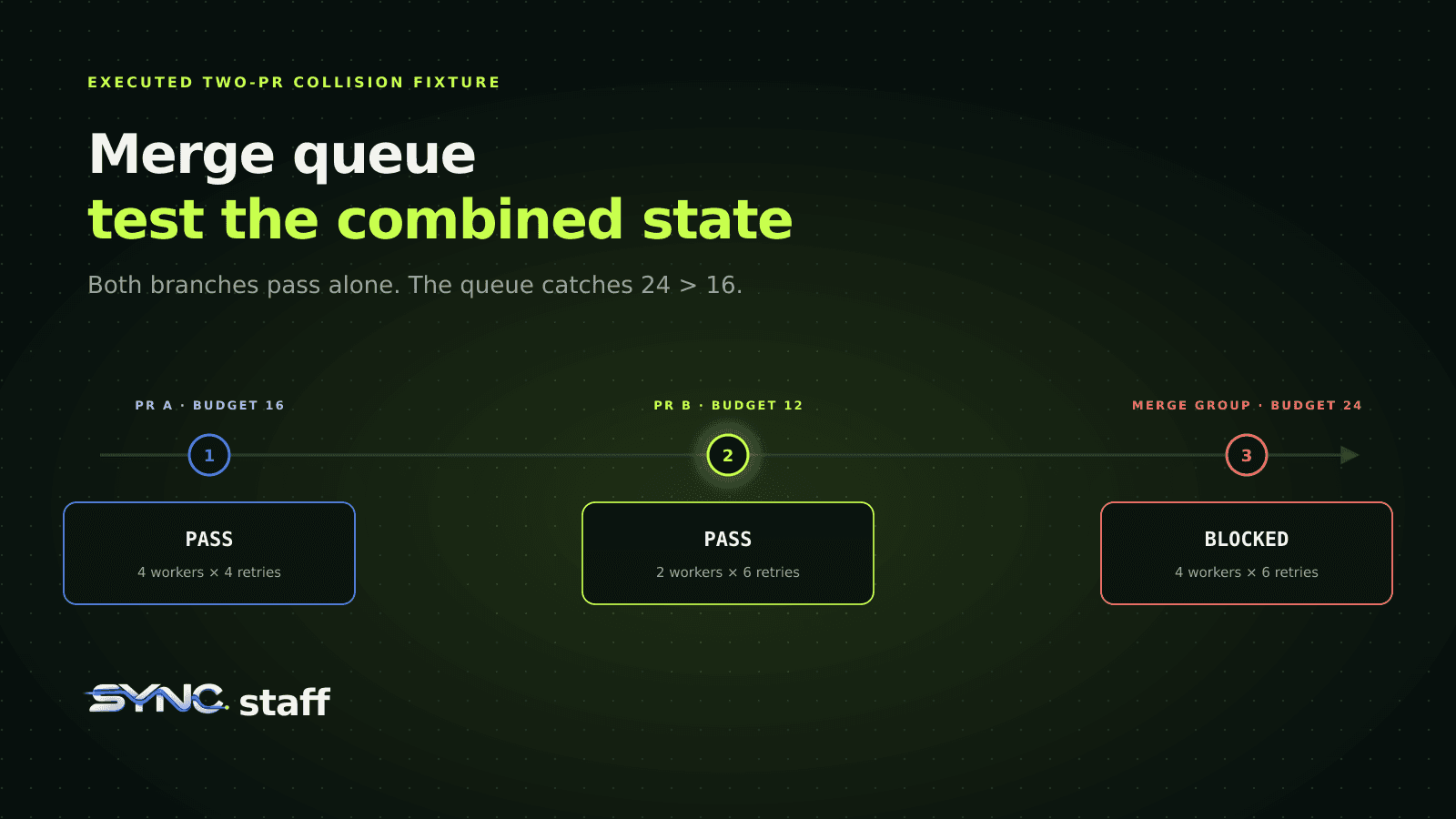
A GitHub merge queue retests an approved pull request against the latest target branch and the changes ahead of it before merging. That matters when coding agents produce pull requests faster than a team can safely integrate them. Two PRs can each pass against the same stale main and still fail when combined. The queue turns that hidden integration risk into a required check before the shared branch changes.
What is a GitHub merge queue?
A merge queue is an ordered gate between pull-request approval and the target branch. It creates a temporary combined revision from the latest base branch, the queued pull request, and sometimes earlier queued changes. CI runs against that combined state. The pull request lands only if the required checks pass.
That is different from simply requiring a PR branch to be up to date. GitHub's queue updates and tests the integration state without making every author repeatedly merge main into a branch. It also preserves an order when several approved changes are waiting.
The basic flow is:
- A pull request passes its normal review and required PR checks.
- Someone with permission adds it to the queue.
- The queue combines it with the latest target branch and changes ahead of it.
- CI runs against that temporary merge group.
- A passing group lands. A conflicting or failing pull request leaves the queue for revision.
A merge queue does not review code, choose the right tests, or fix conflicts. It gives those controls the combined revision they actually need to evaluate.
If several pull requests depend on one another before they reach the queue, use GitHub stacked pull requests to make the layer order and bottom-up review path explicit.
Why coding agents make merge queues more useful
Coding agents make branches cheap. They do not make integration cheap.
With one developer and two open pull requests, a team can often merge manually and repair the occasional conflict. With several agents producing changes in parallel, there are more plausible interactions:
- one agent changes an API response while another updates its consumer
- two agents independently add a migration with the same sequence number
- a refactor removes a path that a second PR has started using
- two individually valid configuration edits produce an invalid combined value
- a test-selection rule skips the test that would expose the interaction
- a flaky required check repeatedly ejects otherwise valid work
Claude Code worktrees and Codex worktrees isolate agents while they edit. Git worktree vs branch explains why that filesystem isolation is useful. None of those mechanisms proves that the resulting changes work together.
A queue covers the next boundary: after a person approves each change, but before the changes share main.
Our two-PR collision test
We built a deterministic local Git fixture to test the exact failure a merge queue is meant to catch. The baseline has two policy values: two queue workers and four retries, for a retry budget of eight. The acceptance check rejects any combined budget above 16.
PR A changes only workers.txt, increasing workers from two to four. Against the unchanged retry count of four, its budget is 16 and the check passes. PR B changes only retries.txt, increasing retries from four to six. Against the unchanged worker count of two, its budget is 12 and the check also passes.
Git then merged both branches without a textual conflict. The combined values were four workers and six retries, for a budget of 24. The same acceptance check exited 1 and blocked the merge group.
| Revision tested | Git merge | Acceptance check | Observed budget |
|---|---|---|---|
| Baseline configuration | Not applicable | Within the limit | 8 |
| Base + PR A | Clean commit | Pass, exit 0 | 16 |
| Base + PR B | Clean commit | Pass, exit 0 | 12 |
| Base + PR A + PR B | Both merges exit 0 | Fail, exit 1 | 24 |
The saved output ended with:
workers=4 retries=6 retry_budget=24
FAIL: retry budget exceeds the supported limit of 16
PASS: merge-group verification caught a semantic collision
This is a synthetic local fixture, not a performance benchmark for GitHub or any CI provider. It proves one narrow point: two branches can merge cleanly and pass alone while their combined state violates a shared requirement. The script, output, hashes, and scope limitation are preserved with the article's validation evidence.
Configure GitHub Actions for a merge queue
GitHub's merge queue guide explains the branch-protection setup and queue controls. GitHub Actions workflows that provide required checks need to listen for merge_group as well as pull_request. The workflow events reference documents that trigger. Without it, the queue can wait for a required check that never runs.
A minimal trigger looks like this:
name: required-ci

on:
  pull_request:
  merge_group:

jobs:
  verify:
    runs-on: ubuntu-latest
    steps:
      - uses: actions/checkout@v4
      - uses: actions/setup-node@v4
        with:
          node-version: 22
          cache: npm
      - run: npm ci
      - run: npm test
The important detail is not the syntax alone. The workflow must test the checked-out merge-group revision. Do not reconstruct the original pull-request head and accidentally run the required check against the wrong commit.
For third-party CI, GitHub creates temporary branches using the gh-readonly-queue/{base_branch} prefix. Configure the provider to build those branches and report required status checks for their SHAs. Confirm the current plan and repository eligibility in GitHub's documentation before making the queue part of your delivery policy.
After the workflow is ready:
- Add its stable check name to the target branch's required checks.
- Enable the merge queue in the branch rule or ruleset.
- Start with low build concurrency and a group size of one.
- Add two known-compatible PRs and verify the queue path end to end.
- Inject a known combined failure and confirm that it cannot land.
- Increase concurrency or group size only after measuring wait time and rebuilds.
Split fast PR feedback from combined-state verification
Running the entire test suite on every event is safe but can make the queue the new bottleneck. Running only affected tests is fast but can miss interactions when the dependency map is incomplete.
Use layered checks:
| Layer | Revision | Purpose | Typical scope |
|---|---|---|---|
| Local agent check | Agent worktree | Catch obvious defects before a PR | formatter, linter, focused unit tests |
| Pull-request check | PR head or PR merge ref | Give the author fast feedback | changed-package tests, type checks, review policy |
| Merge-group check | Latest base plus queued changes | Protect the shared branch | integration tests, contract tests, required build |
| Post-merge check | Updated target branch | Detect environment or deployment problems | full regression, deployment verification |
Test impact analysis can shorten PR feedback by selecting tests related to changed files. Treat it as a speed tool, not proof that unrelated code cannot break. Keep tests for cross-package contracts, schemas, configuration, migrations, and shared interfaces in the merge-group gate even when neither PR's file list selects them.
A useful first design is:
- fast formatting, type, and affected-unit checks on every PR
- a stable integration suite on every merge group
- the full slow suite on a schedule or after merge
- promotion of any escaped regression into the required merge-group suite
The gate should evolve from failures you have actually seen. Our AI agent testing guide shows how to define the observable contract first and keep the evidence independent of the agent that produced the change.
Classify failures before retrying them
An automatic retry is appropriate only when it answers a real question. Re-running every red check until it turns green hides defects and burns CI capacity.
| Failure class | Signal | Queue action |
|---|---|---|
| Merge conflict | Git cannot construct the combined revision | Remove the PR, update it, and review the resolution |
| Deterministic test failure | The same assertion fails on the same SHA | Remove the PR and fix the code or test |
| Infrastructure failure | Runner loss, network outage, provider error | Retry within a small documented budget |
| Known flake | A tracked nondeterministic test fails | Apply the quarantine or retry policy, then record the event |
For flaky test management, give each retry a ceiling. One retry for a known infrastructure signature may be reasonable. Five blind retries are not evidence of quality.
Track first-pass merge-group success, deterministic failures, infrastructure failures, retries per successful merge, time waiting for a runner, setup and test time, queue removals by reason, and quarantined tests with their owners. If a flaky test is required, it controls delivery whether the team admits it or not. Give the quarantine an owner and an expiry date.
Tune queue settings with evidence
GitHub exposes settings for build concurrency, status-check timeout, merge method, and minimum and maximum merge limits. Each changes throughput and failure cost.
Start conservatively:
- Build concurrency: begin near dependable runner capacity, not the maximum the interface allows.
- Group size: begin with one PR per merge. Larger groups help only when failures are rare and easy to isolate.
- Status timeout: set it above normal end-to-end CI time but below the point where a dead run blocks the queue for hours.
- Queue jumping: reserve it for real emergencies. Moving a PR to the front changes the commit graph and can make in-progress entries rebuild.
- Failure policy: keep known-failing work out of groups unless the team has measured a specific reason to combine it.
Measure queue wait, setup, execution, and rebuild time separately. "CI took 18 minutes" does not tell you whether the fix is another runner, dependency caching, smaller groups, or a more reliable test suite.
Keep review approval separate from merge authorization
A reviewed pull request answers: "Is this change understandable and acceptable on its own?"
A passing merge group answers: "Does this accepted change still work with the current target branch and the accepted changes ahead of it?"
Those are different decisions. Keep both visible. For agent-produced changes, require the PR to carry the task and intended outcome, affected components, checks run before submission, known dependencies on other open work, the human reviewer, and the final queue result.
Human-in-the-loop AI agents explains why a named person should remain responsible for consequential changes. The queue supports that review process. It does not replace it.
Automated reviewers can add evidence before that decision; our Claude Code Review guide separates hosted PR review, local review, CI, and human approval.
Where SYNCStaff fits, and where it does not
SYNCStaff coordinates work before the queue. Agents can record work intent, surface file overlap, and leave a shared record for a human reviewer. That can prevent agents from unknowingly changing the same owned area and can make a later conflict easier to understand.
SYNCStaff does not run GitHub's merge queue, execute CI, select tests, or certify that code is safe. The repository host and CI provider remain responsible for the final integration gate.
The useful sequence is:
- coordinate ownership before agents edit
- isolate each task in its own branch or worktree
- run local and pull-request checks
- have a person review the change
- add the approved PR to the merge queue
- require the combined revision to pass
- merge, deploy, and observe through the team's normal controls
This closes two different gaps: early coordination reduces avoidable overlap, and the queue catches interactions that remain.
If a bad change still lands, the GitHub rollback to previous commit guide shows how to preserve later work while choosing between a revert and a tested fix-forward.
A merge queue rollout checklist
Before requiring the queue on main, verify all of these:
- Required CI listens for
merge_group. - The workflow tests the merge-group SHA, not the original PR head.
- A compatible test PR successfully reaches
main. - A known combined failure is rejected.
- Check names remain stable across PR and merge-group workflows.
- Infrastructure retries have a documented limit.
- Flaky tests have owners and quarantine expiry dates.
- Queue wait, setup, run, and rebuild time are measured separately.
- Emergency queue jumping has a named approval rule.
- Human review remains required before queue entry.
- Agent task ownership and dependencies are recorded before work begins.
A merge queue is most valuable when it is boring: approved changes enter, CI tests the state that would actually land, compatible work moves through, and failures return with a precise reason. If your agents already work in parallel, add this integration gate before increasing their output further.
Frequently asked questions
What is a GitHub merge queue?
A GitHub merge queue is an ordered gate that tests an approved pull request against the latest target branch and changes ahead of it before merging. It creates a temporary combined revision, runs required CI checks, and lands the change only when that integration state passes.
Why use a merge queue with coding agents?
Coding agents can create pull requests faster and in greater parallel than a team can safely integrate manually. A merge queue catches interactions that branch-level tests miss, such as two individually valid changes that break a shared contract, configuration value, migration sequence, or integration test when combined.
How do I trigger GitHub Actions for a merge queue?
Add the merge_group event to every GitHub Actions workflow that reports a required queue check, alongside pull_request when appropriate. The workflow must test the checked-out merge-group revision. Without that trigger, the queue can wait for a required status that never runs and reject the merge.
Should a merge queue run the full test suite?
Run enough tests on the merge group to protect the combined state. Affected tests can provide fast pull-request feedback, but shared contracts, schemas, migrations, configuration, and integration paths usually need a stable required queue suite. Run slower regression checks after merge or on a schedule when appropriate.
Does a merge queue replace code review?
No. Code review decides whether a change is understandable and acceptable on its own. The merge queue decides whether that approved change still passes when combined with the latest base and earlier queued work. Agent-produced changes should pass both a named human review and the required combined-state checks.